From Fast Digitization to Controlled Batch Execution: Why CDMOs Need Flexible eBR Strategies
Bridging the Gap Between Rapid Digital Transformation and Precise, Compliant Execution
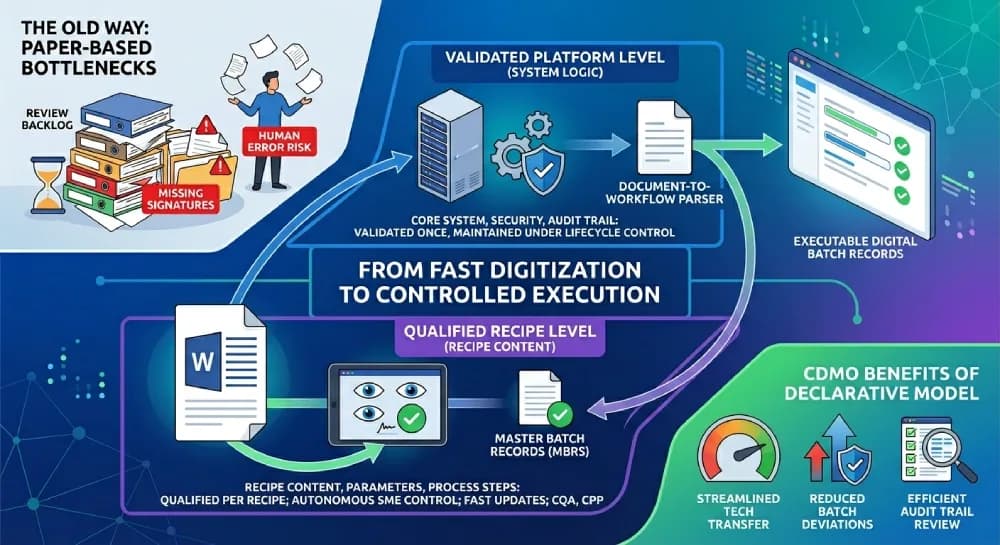
Many contract development and manufacturing organizations (CDMOs) and commercial pharmaceutical manufacturers find themselves under intense pressure to phase out paper-based batch records. The fundamental arguments for this transition are clear: paper slows down the review process, breeds a steady stream of preventable human transcription errors, traps valuable shop-floor data in physical binders, and turns regulatory audits into highly labor-intensive retrieval operations.
However, when searching for an Electronic Batch Record (eBR) or Manufacturing Execution System (MES) solution, it is easy to prioritize the speed of the initial digitization over the long-term operational and validation reality.
The most attractive path is often the onepromising the fastest route from paper to screen. Quickly translating a PDF form, guiding operators through basic digital checklists, and displaying a web-rendered dashboard may appear to solve the immediate problem. But in a regulated GxP environment, rapid deployment is only one part of the story. The decisive question for CDMOs is not simply how fast a batch record can be digitized today, but whether the resulting digital execution model can be operated, updated, qualified, and scaled in a controlled, autonomous way over time.
The Shop Floor Reality: Where "Fast" Digitization
Turn Into Validation Bottlenecks
Traditional MES and eBR environments often suffer from a structural challenge: they couple recipe logic and execution workflows directly with application code and complex database configurations. To understand why this is a significant operational challenge for CDMOs, it is helpful to look past conceptual software demos and step onto the manufacturing floor.
Imagine a typical multi-product facility. A single production line might handle three different customer products in a single week. To accommodate these variants, the production team must manage a vast and growing portfolio of Master Batch Records (MBRs). Consider what happens when a practical change is required:
· A deviation investigation reveals that a blending step needs to be extended from 10 to 12 minutes.
· A raw material supplier changes, requiring an adjustment to the nominal entry value of an active ingredient.
· A customer requests an additional in-process control checkbox to capture an extra analytical measurement.
In a paper-based world, this change is theoretically simple: an author updates a text template, prints a new master sheet, gets QA to sign off, and places it in the batch folder. It is adaptable, but because there are no built-in digital guards, it scales poorly, leading to missing signatures, illegible corrections, and backlogs during the final batch review.
In a traditional computerized MES, however, the digital solution can introduce a different type of bottleneck. Recipe changes are frequently implemented as workflow or configuration changes within the system environment. Whether such a modification results in a limited review or a broader validation effort is not determined by the software alone, but by the site’s change control framework and the risk classification defined by the Validation Owner.
In practice, such modifications are often introduced as a new recipe version under formal change management and, depending on the assessed risk and product impact, may require documented impact assessment and risk-proportionate qualification activities. The same GMP principle applies to anicomply: the QA review, approval, and release process remains unchanged. The difference lies in the fact that using Word as the authoring environment can significantly accelerate the technical implementation of the recipe change, while the quality governance process remains the same.
Instead of a paper bottleneck, the manufacturer may create an expensive digital bottleneck. The process team must wait weeks—and allocate significant engineering and validation resources—just to alter a single number in a recipe. For a CDMO, whose business model relies on speed, technology transfers, and responsiveness to customer-driven modifications, this rigidity can represent a serious constraint for CDMO responsiveness.
The Strategic Shift: Separating System Logic from Recipe Content
To solve this dilemma, pharmaceutical manufacturers require an architectural shift where agility and compliance support one another. The solution lies in a structural separation of system validation and recipe management. This is the core architectural principle behind a declarative recipe model.
In a traditional procedural system, every recipe is essentially treated as a custom software configuration that needs individual validation. In contrast, a declarative model defines what the process should do, while the underlying execution engine remains structurally constant.
In a declarative recipe model, recipes can be authored and maintained in standard, familiar text processing environments—such as Microsoft Word—using document structures that formulation scientists, process engineers, and quality professionals already operate every day. There is no custom system code or proprietary vendor modeling programming required.
A validated, deterministic transformation engine then parses this structured document into fully executable, guided digital batch record workflows. This transformation takes place entirely within a defined, validated system boundary.
The Two-Tier Validation Framework: Risk-Proportionate GAMP 5 Alignment
How does this separation work from a regulatory and validation perspective? It establishes a clear, two-tier model that can support a risk-based validation approach following GAMP 5 and the lifecycle approach of ICH Q10:
1. Validated at the Platform Level and Maintained under Lifecycle Control
The software platform itself—including the document-to-workflow parser, the core database, the security architecture, the role-based access controls, and the electronic signature and audit trail mechanisms—is validated at the application level and maintained under continuous lifecycle control. This confirms that the system can reliably, repeatably, and deterministically transform any compliant recipe input into a secure digital recipe workflow without altering system behavior.
2. Qualified per Recipe at the Content Level
Because the system behavior remains constant, modifying a parameter or adding a process step in a Word document does not touch the system code or application configuration. This can therefore limit the need for broad software regression testing, provided the change remains within the validated system boundaries. Instead, the new or updated recipe is qualified at the content level:
· Process correctness: Are the steps in the correct order for this specific product?
· Parameter accuracy: Are the limit values chemically and procedurally sound?
· Four-eyes principle: A formal, system-governed review and approval workflow ensures that QA and production managers sign off on the recipe content within the software before it is made available for execution on the shop floor.
· Patient risk (primary assessment criterion): In alignment with a risk-based GAMP 5 approach, the foremost evaluation criterion is whether the proposed recipe change may affect product quality, patient safety, critical quality attributes (CQAs), critical process parameters (CPPs), or the validated state of the manufacturing process. Where such impact cannot be excluded, the change shall be subject to formal impact assessment, documented quality review, and risk-proportionate qualification prior to release for operational use.
By scoping change control and validation proportionately to the actual risk of the modification, CDMOs can move from lengthy technical change cycles to faster, content-focused review and approval processes.
Reducing Technical Overhead and Empowering Process Teams
The operational advantages of this declarative architecture extend far beyond validation savings. In a traditional MES setup, manufacturers are trapped in a cycle of constant dependency on external system integrators or specialized IT departments. If a customer demands a minor tweak to a reporting format, a ticket must be opened, a quotation reviewed, and a developer scheduled.
By utilizing familiar desktop tools as the authoring environment, a declarative approach shifts the control back to the scientists and process specialists who plan the manufacturing steps. The subject matter expert (SME) has the autonomy to draft, update, and refine recipes within the qualified boundaries.
This lean process, with a clear separation of concerns of digital authoring, provides synergies for critical business outcomes:
· Streamlined technology transfer timelines: Onboarding a new customer and translating their paper process into a compliant digital structure becomes a straightforward authoring task rather than a multi-month database engineering project.
· Measurable reduction in batch deviations: Because operators are guided by a structured, system-enforced workflow that verifies mandatory fields, checks inputs against limits in real-time, and captures contemporaneous data (ALCOA+), the volume of transcription and sequence errors can be reduced significantly.
· Efficient audit trail review: Instead of wading through massive, unformatted raw technical log files, QA teams are presented with context-specific audit trails, showing precisely who entered what parameters, when they did it, and why any manual corrections were taken.
Conclusion: True Agility is an Architecture, Not a Fast Go-Live
Transitioning to an electronic batch record system is a major milestone for any CDMO. But digitalizing paper files by simply overlaying quick digital mockups or piling complex, procedural MES layers on top of agile manufacturing processes is a short-sighted strategy. The fastest route to digitization is not always the most sustainable route under GMP conditions.
For contract manufacturers who must routinely manage high process variance, frequent customer-led changes, and rapid product transfers, true agility is an architectural outcome. It requires a system designed to enable change as a lean process, rather than treating every minor adjustment as a new validation effort.
By separating stable, validated execution logic from dynamic recipe content, the declarative model enables CDMOs to maintain consistent, audit-ready control while achieving the operational speed and cost efficiency that commercial markets demand. Introducing an eBR is a necessary first step—but deploying an architecture that you can independently control, adapt, and run over the long haul is what ultimately defines a successful digital transformation.
The strategic case for this transformation is becoming even stronger as artificial intelligence (AI) and data analytics move from optional innovation topics to core capabilities in pharmaceutical operations and regulation. A paper-based or weakly structured execution environment does not merely slow batch review; it also limits the availability, consistency, and contextual integrity of manufacturing data. For CDMOs and pharmaceutical manufacturers, this means that digitization must be designed not only for operational efficiency, but also as a deliberate foundation for future-ready data use, advanced process insight, exception trending, knowledge reuse, and AI-supported decision making. In this sense, digital batch execution is no longer only an efficiency initiative; it is a strategic prerequisite for data-driven manufacturing and continuous improvement.
This direction is also reinforced by regulators. The European Medicines Agency (EMA) has explicitly positioned digitalisation, data, and AI as strategic priorities for the European medicines regulatory network and has linked regulatory modernisation to the broader use of structured data, analytics, and digital tools. Similarly, the U.S. Food and Drug Administration (FDA) has advanced technology and data modernisation as part of its regulatory mission and has published positions on the growing role of AI and data-driven methods across the drug product lifecycle, including manufacturing and quality-related decision making. As a result, manufacturers that continue to rely on paper-centric or weakly digitised execution models risk falling behind both operationally and in their long-term regulatory readiness.
Selected official references: EMA Strategy on digitalisation; EMA/HMA joint strategy to 2028; EMA Artificial intelligence page; FDA Technology Modernization Action Plan; FDA Data Modernization Action Plan; FDA Office of Digital Transformation; FDA Artificial Intelligence for Drug Development.
Additional background on digital batch workflows for CDMO environments is available here: https://www.anic-gmbh.de/en/products/anicomply/cdmo