Polpharma API | Polpharma API | CDMO
PolandSERVICESPARTICLE ENGINEERINGCHEMICAL-SYNTHETICOLIGONUCLEOTIDES
Integrated CDMO solutions for HP APIs (OEB 6), ADC payload-linkers and oligonucleotides from development to GMP supply.
Über die Pflanze
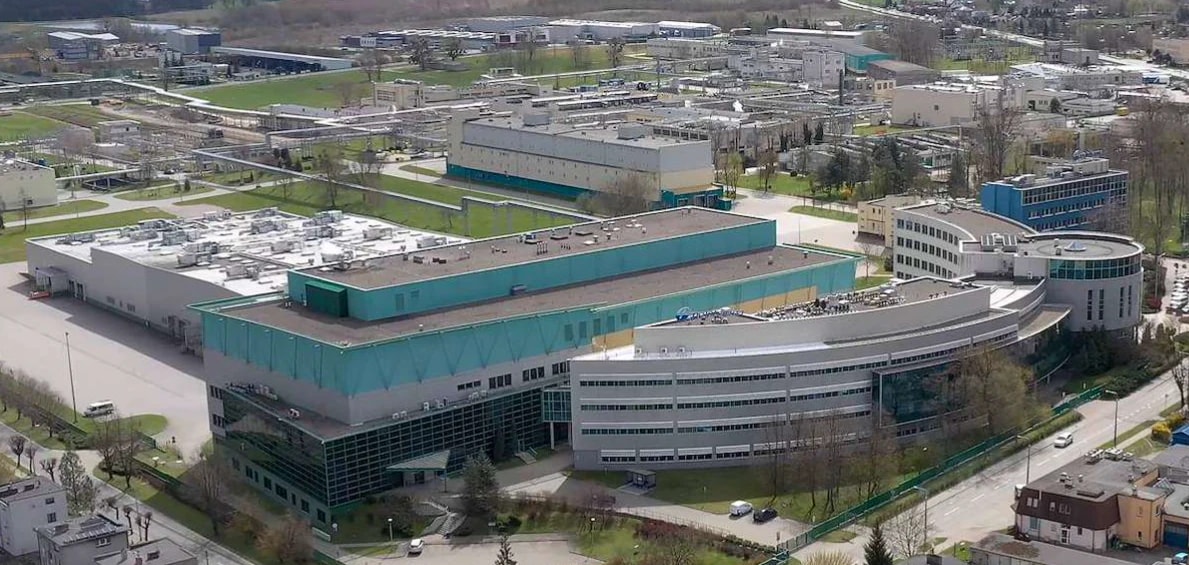
Service scope- End-to-end CDMO: process development, technology transfer, cGMP manufacturing, process validation, regulatory support, and commercial supply.- Covers clinical phases from Phase I through Phase III, registration, and commercial manufacturing — all under one roof at a single site.- Typical contract-to-delivery: ~4–6 months (short, non-complex routes) to ~10–12 months (multistep, complex chemistry).Manufacturing scale & capacity- Total installed capacity: ~370 m³ across 227 reactors (incl. ~12 × 4,000 L and ~12 × 6,300 L).- Reactor range 5 L to 6,300 L — glass-lined, stainless steel, and Hastelloy.- Batch scale: kilo lab up to 3 kg → pilot plant up to 40 kg → commercial 30–800 kg.- Volume support per product: ~500 kg/year at launch, scaling to ~2,800–4,500 kg/year at peak demand for that product.Technical capabilities- High-potency (HPAPI) & oncology: containment to OEL 10 ng/m³ (OEB 6); two kilo labs (one RABS, one isolator); contained charging (isolators, split butterfly valves); dispensing, isolation, drying, milling and packaging performed in isolators. Dedicated HP API facility (R&D, QC, small-scale production).- Payload–Linkers for ADC: synthesis of the payload–linker component (mAb and conjugation handled via partners). Scope: route development, process development, analytical development and GMP manufacture of the payload–linker intermediate, delivered as a characterized chemical entity for conjugation elsewhere.- Oligonucleotides: dedicated GMP oligonucleotide manufacturing area; solid-phase synthesis, chromatographic purification, ultrafiltration, lyophilization; low endotoxin levels. Established in single-stranded ASO chemistry; double-stranded siRNA in development. Batches up to 50 g, supporting clinical development and early commercial supply.- Cryogenic chemistry: operation to −90 °C; two cryogenic installations (pilot 150 L & 400 L; commercial 2,500 L & 6,300 L) plus kilo lab; deep n-BuLi / organometallic experience.- Synthetic chemistry: hydrogenation (Pd/C, Ru/C, Pt/C, Pd(OH)₂/C, Raney Ni; to 10 bar commercial, 150 bar in R&D), Grignard, lithiation, bromination, triflation, amidation, oxidation/reduction, coupling.- Particle engineering: jet milling to d90 <10 µm; contained pin-milling for potent compounds to d90 <15 µm (30–40 kg/h); milling on pin mills and hammer mills; micronization; controlled crystallization / polymorph screening (solid-state chemistry lab).- Chromatographic purification: preparative chromatography at R&D and production scale, with capability currently being extended into the HP API facility.- Temperature range −90 °C to +160 °C; pressure to 10 bar at commercial scale.Analytical & development- In-house: HPLC/UPLC (UV-Vis PDA, RI, CAD), XRPD, DSC, TGA, LC-MS, GC, IC, KF, microbial testing; method development & validation; stability program (Novatek).- Specialist impurity work incl. genotoxic/nitrosamine control and green-solvent route redesign.- ICP-MS and NMR performed at qualified external laboratories.- ISO/IEC 17025-aligned laboratory practice.Quality & regulatory track record- Independent Quality unit covering both Quality Assurance (QA) and Quality Control (QC), with final authority on all quality decisions.- Pharmaceutical Quality System per cGMP / EU GMP Part II (ICH Q7); QRM per ICH Q9.- Inspected by FDA (1995, 1997, 1999, 2004, 2009, 2012, 2015, 2018), and by EMA/PIC-S authorities, PMDA (Japan), ANVISA (Brazil), and KFDA (Korea); GMP certificates listed in EudraGMP.- EU–US mutual recognition: for ANDA filings, the Polish authority's GMP report is accepted by FDA (no separate facility inspection required).- Client quality audits accommodated annually (and for-cause).- ISO 14001 (environmental) and ISO 45001 (occupational H&S) certified; EcoVadis Silver, 74/100.Best fitBiotech and pharmaceutical companies developing demanding molecules — high-potency and oncology compounds, ADC payload–linkers, and oligonucleotides — that want an FDA-inspected European partner with high-containment expertise and a proven regulatory track record to carry projects from early clinical batches to commercial scale.
Attribute und Fähigkeiten
Category / Product
- OLIGONUCLEOTIDES
- PARTICLE ENGINEERING
- SERVICES
Batch Size
- Small
- Medium
- Large
Stage
- Commercial (Phase IV)
Services
- Regulatory services
Information
Standort
Starogard Gdański, Poland
Pelplińska 19